What Are Some Ways That Art Can Be Used on Television or in Movies?

Video art is an art class which relies on using video applied science as a visual and audio medium. Video art emerged during the belatedly 1960s as new consumer video engineering science such equally video tape recorders became available outside corporate broadcasting. Video art tin can take many forms: recordings that are broadcast; installations viewed in galleries or museums; works streamed online, distributed equally video tapes, or DVDs; and performances which may comprise one or more television sets, video monitors, and projections, displaying live or recorded images and sounds.[ane]
Video art is named for the original analog video tape, which was the most commonly used recording technology in much of the form history into the 1990s. With the advent of digital recording equipment, many artists began to explore digital technology as a new way of expression.
One of the key differences between video art and theatrical movie house is that video art does not necessarily rely on many of the conventions that define theatrical cinema. Video fine art may not use the use of actors, may contain no dialogue, may have no discernible narrative or plot, and may not adhere to any of the other conventions that more often than not define motility pictures as amusement. This distinction too distinguishes video art from movie theatre'south subcategories such as avant garde cinema, short films, or experimental film.
Early on history [edit]
Nam June Paik, a Korean-American artist who studied in Deutschland, is widely regarded every bit a pioneer in video art.[two] [3] In March 1963 Nam June Paik showed at the Galerie Parnass in Wuppertal the Exposition of Music – Electronic Tv set.[4] [5] In May 1963 Wolf Vostell showed the installation six Goggle box Dé-coll/age at the Smolin Gallery in New York and created the video Sunday in your head in Cologne. Originally Sun in your head was made on 16mm film and transferred 1967 to videotape.[6] [7] [8]
Video art is ofttimes said to have begun when Paik used his new Sony Portapak to shoot footage of Pope Paul VI'due south procession through New York Urban center in the autumn of 1965[9] Afterward that same 24-hour interval, across town in a Greenwich Hamlet cafe, Paik played the tapes and video art was born.
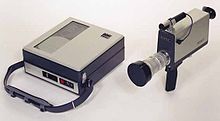
Prior to the introduction of consumer video equipment, moving paradigm production was only available not-commercially via 8mm film and 16mm picture show. After the Portapak's introduction and its subsequent update every few years, many artists began exploring the new technology.
Many of the early on prominent video artists were those involved with concurrent movements in conceptual fine art, functioning, and experimental film. These include Americans Vito Acconci, Valie Export, John Baldessari, Peter Campus, Doris Totten Chase, Maureen Connor, Norman Cowie, Dimitri Devyatkin, Frank Gillette, Dan Graham, Gary Hill, Joan Jonas, Bruce Nauman, Nam June Paik, Pecker Viola, Shigeko Kubota, Martha Rosler, William Wegman, and many others. There were as well those such as Steina and Woody Vasulka who were interested in the formal qualities of video and employed video synthesizers to create abstruse works. Kate Craig,[10] Vera Frenkel[xi] and Michael Snowfall[12] were important to the development of video art in Canada.
In the 1970s [edit]
Much video fine art in the medium's heyday experimented formally with the limitations of the video format. For example, American artist Peter Campus' Double Vision combined the video signals from two Sony Portapaks through an electronic mixer, resulting in a distorted and radically dissonant image. Some other representative piece, Joan Jonas' Vertical Curlicue, involved recording previously-recorded material of Jonas dancing while playing the videos back on a television receiver, resulting in a layered and circuitous representation of mediation.

A notwithstanding from Jonas' 1972 video
Much video fine art in the The states was produced out of New York City, with The Kitchen, founded in 1972 by Steina and Woody Vasulka (and assisted past video managing director Dimitri Devyatkin and Shridhar Bapat), serving as a nexus for many young artists. An early multi-aqueduct video art work (using several monitors or screens) was Wipe Wheel by Ira Schneider and Frank Gillette. Wipe Bicycle was offset exhibited at the Howard Wise Gallery in New York in 1969 equally part of an exhibition titled "TV every bit a Creative Medium". An installation of nine television screens, Wipe Cycle combined live images of gallery visitors, found footage from commercial tv set, and shots from pre-recorded tapes. The material was alternated from i monitor to the next in an elaborate choreography.
On the West coast, the San Jose Country television studios in 1970, Willoughby Sharp began the "Videoviews" series of videotaped dialogues with artists. The "Videoviews" series consists of Sharps' dialogues with Bruce Nauman (1970), Joseph Beuys (1972), Vito Acconci (1973), Chris Brunt (1973), Lowell Darling (1974), and Dennis Oppenheim (1974). Also in 1970, Sharp curated "Body Works", an exhibition of video works past Vito Acconci, Terry Flim-flam, Richard Serra, Keith Sonnier, Dennis Oppenheim and William Wegman which was presented at Tom Marioni'south Museum of Conceptual Fine art, San Francisco, California.
In Europe, Valie Consign's groundbreaking video slice, "Facing a Family" (1971) was ane of the first instances of tv set intervention and broadcasting video art. The video, originally broadcast on the Austrian boob tube program "Kontakte" February 2, 1971,[11] shows a bourgeois Austrian family unit watching TV while eating dinner, creating a mirroring event for many members of the audition who were doing the same matter. Export believed the idiot box could complicate the relationship betwixt bailiwick, spectator, and tv.[13] [14] In the United kingdom of great britain and northern ireland David Hall's "Boob tube Interruptions" (1971) were transmitted intentionally unannounced and uncredited on Scottish TV, the beginning creative person interventions on British television.
1980s-1990s [edit]

As the prices of editing software decreased, the access the general public had to use these technologies increased. Video editing software became so readily available that it changed the way digital media artists and video artists interacted with the mediums. Different themes emerged and were explored in the artists work, such as interactivity and nonlinearity. Criticisms of the editing software focused on the freedom that was created for the artists through the technology, but not for the audience. Some artists combined physical and digital techniques to let their audience to physically explore the digital work. An instance of this is Jeffrey Shaw's "Legible City" (1988–91). In this piece the "audience" rides a stationary bicycle through a virtual images of Manhattan, Amsterdam, and Karlsrule. The images change depending on the direction of the bike handles, and the speed of the pedaler. This created a unique virtual experience for every participant.
Subsequently 2000 [edit]
As technology and editing techniques have evolved since the emergence of video as an art grade, artists have been able to experiment more with video fine art without using any of their own content. Marco Brambilla'due south Civilization (2008) shows this technique. Brambilla attempts to make a video version of a collage, or a "video landscape" [15] by combining various clips from movies, and editing them to portray sky and hell.[16]
At that place are artists today who have inverse the way video art is perceived and viewed. In 2003, Kalup Linzy created Conversations Wit De Churen Two: All My Churen, a lather opera satire that has been credited as creating the video and performance sub-genre[17] Although Linzy's work is genre defying his work has been a major contribution to the medium. Ryan Trecartin, and experimental young video-creative person, uses color, editing techniques and bizarre acting to portray what The New Yorker calls "a cultural watershed".[18] [19] Trecartin played with the portrayal of identity and ended up producing characters who "tin can exist many people at the aforementioned fourth dimension".[18] When asked about his characters, Trecartin explained that he visualized that each person'southward identity was made upwardly of "areas" and that they could all be very dissimilar from each other and exist expressed at different times.[18] Ryan Trecartin is an innovative artist who has been said to accept "changed the way nosotros engage with the globe and with one another"[nineteen] through video art. A series of videos made by Trecartin titled I-BE-AREA displayed this, one example is I-Exist-Surface area (Pasta and Wendy M-PEGgy), which was made public in 2008, which portrays a character named Wendy who behaves erratically. When asked well-nigh his characters, Trecartin explained that he visualized that each person'southward identity was made up of "areas" and that they could all be very different from each other and exist expressed at different times.[18] Ryan Trecartin is an innovative artist who has been said to have "changed the fashion we engage with the world and with one another"[19] through video fine art. In 2008, New York Times Kingdom of the netherlands Cotter writes, 'A big difference between his work and Mr. Trecartin'southward is in the degree of digital engagement. Mr. Trecartin goes wild with editing bells and whistles; Mr. Linzy does not. The plainness and occasional clunkiness of his video technique is one reason the Braswell serial ends upward touching in a way that Mr. Trecartin'due south buzzed-upwardly narratives rarely are. For all their raunchy hilarity Mr. Linzy's characters are more than cartoons; "All My Churen" is a family unit-values story that has a lot to do with life.[20]
Performance art and video fine art [edit]
Video art as a medium can as well be combined with other forms of creative expression such as Performance art. This combination can likewise be referred to as "media and performance art" [21] when artists "intermission the mold of video and film and broaden the boundaries of art".[21] With increased power for artists to obtain video cameras, functioning art started being documented and shared beyond large amounts of audiences.[22] Artists such as Marina Abramovic and Ulay experimented with video taping their performances in the 1970s and the 1980s. In a piece titled "Residual energy" (1980) both Ulay and Marina suspended their weight so that they pulled dorsum a bow and arrow aimed at her heart, Ulay held the arrow, and Marina the bow. The piece was iv:10 which Marina described as existence "a operation about complete and full trust".[23]
Other artists who combined Video fine art with Performance fine art used the camera as the audience. Kate Gilmore experimented with the positioning of the photographic camera. In her video "Anything" (2006) she films her functioning piece equally she is constantly trying the attain the photographic camera which is staring downward at her. As the xiii-infinitesimal video goes on, she continues to tie together pieces of furniture while constantly attempting to reach the camera. Gilmore added an element of struggle to her art which is sometimes self-imposed,[24] in her video "My beloved is an anchor" (2004) she lets her foot dry in cement before attempting to suspension gratis on camera.[25] Gilmore has said to have mimicked expression styles from the 1960s and 1970s with inspirations like Marina Abramovic as she adds extremism and struggle to her piece of work.[26]
Some artists experimented with infinite when combining Video fine art and Performance art. Ragnar Kjartannson, an Icelandic artist, filmed an entire music video with 9 unlike artists, including himself, being filmed in unlike rooms. All the artists could hear each other through a pair of headphones so that they could play the song together, the piece was titled "The visitors" (2012).[27]
Some artists, such equally Jaki Irvine and Victoria Fu have experimented with combining 16 mm film, eight mm film and video to brand utilize of the potential discontinuity between moving image, musical score and narrator to undermine any sense of linear narrative. [28]
As an academic discipline [edit]
Since 2000, video arts programs have begun to emerge amidst colleges and universities equally a standalone field of study typically situated in relation to picture show and older broadcast curricula. Current models plant in universities like Northeastern and Syracuse show video arts offering baseline competencies in lighting, editing and camera functioning. While these fundamentals tin feed into and support existing picture or Idiot box production areas, contempo growth of amusement media through CGI and other special effects situate skills similar blitheness, movement graphics and computer aided design as upper level courses in this emerging area.
Notable video art organizations [edit]
- Ars Electronica Center (AEC), Linz, Republic of austria
- Edith-Russ-Haus for Media Art, Oldenburg, Germany
- Electronic Arts Intermix, New York, NY
- Experimental Idiot box Center, New York
- Goetz Collection, Munich, Germany
- Imai – inter media art plant, Düsseldorf
- Impakt Festival, Utrecht
- Julia Stoschek Collection, Düsseldorf, Germany
- Kunstmuseum Bonn, large video fine art collection
- LA Freewaves is an experimental media art festival with video art, shorts and animation; exhibitions are in Los Angeles and online.
- Lumen Eclipse – Harvard Foursquare, MA
- LUX, London, Great britain
- London Video Arts, London, UK
- Neuer Berliner Kunstverein with its "Video-Forum" established in 1971 – Berlin, Germany
- Perpetual fine art machine, New York
- Raindance Foundation, New York
- Souvenirs from Earth, Art Television Station on European Cable Networks (Paris, Cologne)
- Vtape, Toronto, Canada
- Videoart at Midnight, an artists' cinema project, Berlin, Federal republic of germany
- Video Data Banking company, Chicago, IL.
- VIVO Media Arts Eye, Vancouver, Canada
- ZKM Center for Art and Media Karlsruhe, Germany
- Videobrasil, Associação Cultural Videobrasil, São Paulo, Brazil
See also [edit]
 | Wikimedia Commons has media related to Video art. |
 | Wikiquote has quotations related to: Video art |
- Artmedia
- Experimental motion-picture show
- INFERMENTAL
- Interactive film
- List of video artists
- Music video
- Music visualization
- New media art
- Optical feedback
- Real-time estimator graphics
- Scratch video
- Single-aqueduct video
- Sound art
- Video jockey
- Video poetry
- Video sculpture
- Video synthesizer
- Visual music
- VJ (video functioning creative person)
References [edit]
- ^ Hartney, Mick. "Video fine art" Archived 2011-10-17 at the Wayback Automobile, MoMA, accessed Jan 31, 2011
- ^ "Archived copy" (PDF). Archived (PDF) from the original on 2016-03-04. Retrieved 2016-05-16 .
{{cite spider web}}: CS1 maint: archived copy as championship (link) - ^ Judkis, Maura (12 December 2012). "Nam June Paik at the Smithsonian American Art Museum opens Dec. xiii". washingtonpost.com. Archived from the original on 9 Baronial 2017. Retrieved ix May 2018.
- ^ Netz, Medien Kunst (ix May 2018). "Medien Kunst Netz - Exposition of Music – Electronic Television". world wide web.medienkunstnetz.de. Archived from the original on 9 Baronial 2017. Retrieved nine May 2018.
- ^ Net, Media Fine art (9 May 2018). "Media Art Net - Exhibition unknown". world wide web.medienkunstnetz.de. Archived from the original on 9 Baronial 2017. Retrieved nine May 2018.
- ^ NBK Band 4. Time Pieces. Videokunst seit 1963. Verlag der Buchhandlung Walther König, Köln, 2013, ISBN 978-3-86335-074-1
- ^ Cyberspace, Media Fine art (9 May 2018). "Media Fine art Internet - Vostell, Wolf: Idiot box Décollage". www.medienkunstnetz.de. Archived from the original on 11 May 2012. Retrieved nine May 2018.
- ^ Net, Media Fine art (9 May 2018). "Media Art Net - Vostell, Wolf: Sun in Your Caput". world wide web.medienkunstnetz.de. Archived from the original on 8 Oct 2017. Retrieved 9 May 2018.
- ^ Laura Cumming (December xix, 2010), Nam June Paik – review Archived 2016-11-26 at the Wayback Machine Nam June Paik The Guardian.
- ^ Marsh, James H (1985-01-01). The Canadian encyclopedia. Edmonton: Hurtig Publishers. ISBN088830269X. OCLC 12578727.
- ^ "Vera Frenkel: Archive Fevers - Canadian Fine art". Canadian Art. Archived from the original on 2016-10-22. Retrieved 2016-10-22 .
- ^ Elwes, Catherine (2006-04-26). Video Art, A Guided Tour: A Guided Bout. I.B.Tauris. ISBN9780857735959. Archived from the original on 2018-05-09.
- ^ "Electronic Arts Intermix: Facing a Family, Valie Consign". eai.org. Archived from the original on 2010-12-25.
- ^ Cavoulacos, Sophie (2021-12-21). "VALIE EXPORT's Facing a Family". Museum of Modern Art New York (MoMA) . Retrieved 2022-01-28 .
{{cite web}}: CS1 maint: url-status (link) - ^ "Marco Brambilla: Culture". Motionographer. 2009-03-16. Archived from the original on 2018-03-31. Retrieved 2018-03-03 .
- ^ "Culture (Hell and Heaven) by Marco Brambilla". www.seditionart.com. Archived from the original on 2018-03-31. Retrieved 2018-03-03 .
- ^ 'Theatre of the Self, Performing who you lot are'.
- ^ a b c d Tomkins, Calvin (2014-03-17). "Experimental People". The New Yorker. ISSN 0028-792X. Archived from the original on 2018-03-31. Retrieved 2018-03-30 .
- ^ a b c Solway, Diane. "What You Demand to Know About Lizzie Fitch and Ryan Trecartin, the Artists Behind Kendall and Gigi's Due west Cover Story". Westward Magazine. Archived from the original on 2018-03-31. Retrieved 2018-03-thirty .
- ^ Cotter, Holland. "Video Art Thinks Large: That'southward Showbiz". Retrieved 2018-08-28 .
- ^ a b "MoMA | Performing for the Camera". www.moma.org. Archived from the original on 2018-03-31. Retrieved 2018-03-03 .
- ^ "MoMA | Functioning into Art". world wide web.moma.org. Archived from the original on 2017-12-xv. Retrieved 2018-03-03 .
- ^ "Museum of Modern Art | MoMA". www.moma.org. Archived from the original on 2018-03-31. Retrieved 2018-03-02 .
- ^ "Kate Gilmore | LANDMARKS". landmarks.utexas.edu. sixteen March 2015. Archived from the original on 2016-08-23. Retrieved 2018-03-02 .
- ^ "Break on Through". 2009-07-01. Archived from the original on 2018-03-20. Retrieved 2018-03-02 .
- ^ "Kate Gilmore: Body of Work | MOCA Cleveland". mocacleveland.org. Archived from the original on 2018-03-20. Retrieved 2018-03-03 .
- ^ "Art Star Ragnar Kjartansson Moves People To Tears, Over And Over". NPR.org. Archived from the original on 2018-03-31. Retrieved 2018-03-02 .
- ^ "Jaki Irvine".
Further reading [edit]
- Making Video 'In' - The Contested Ground of Culling Video On The Westward Coast Edited by Jennifer Abbott (Satellite Video Exchange Order, 2000).
- Videography: Video Media every bit Art and Culture past Sean Cubitt (MacMillan, 1993).
- A History of Experimental Moving picture and Video by A. L. Rees (British Film Institute, 1999).
- New Media in Late 20th-Century Art past Michael Rush (Thames & Hudson, 1999).
- Mirror Machine: Video and Identity, edited by Janine Marchessault (Toronto: YYZ Books, 1995).
- Sounding the Gallery: Video and the Rise of Art Music by Holly Rogers (New York: Oxford University Press, 2013).
- Video Culture: A Critical Investigation, edited by John 1000. Hanhardt (Visual Studies Workshop Press, 1986).
- Video Art: A Guided Bout by Catherine Elwes (I.B. Tauris, 2004).
- A History of Video Art by Chris Meigh-Andrews (Berg, 2006)
- Diverse Practices: A Critical Reader on British Video Art edited by Julia Knight (University of Luton/Arts Council England, 1996)
- ARTFORUM February 1993 "Travels In The New Flesh" by Howard Hampton (Printed by ARTFORUM INTERNATIONAL 1993)
- Resolutions: Contemporary Video Practices', (eds. Renov, Michael & Erika Suderburg) (London, Minneapolis: University of Minnesota Printing,1996).
- Expanded Cinema by Gene Youngblood (New York: Eastward.P. Dutton & Visitor, 1970).
- The Problematic of Video Fine art in the Museum 1968-1990 by Cyrus Manasseh (Cambria Press, 2009).
- "Commencement Electronic Art Testify" by (Niranjan Rajah & Hasnul J Saidon) (National Art Gallery, Kuala Lumpur, 1997)
- "Expanded Cinema", (David Curtis, A. Fifty. Rees, Duncan White, and Steven Brawl, eds), Tate Publishing, 2011
- "Retrospektiv-Film-org videokunst| Norge 1960-xc". Edited by Farhad Kalantary & Linn Lervik. Atopia Stiftelse, Oslo, (Apr 2011).
- Experimental Film and Video, Jackie Hatfield, Editor. (John Libbey Publishing, 2006; distributed in North America by Indiana University Press)
- "REWIND: British Artists' Video in the 1970s & 1980s", (Sean Cubitt, and Stephen Partridge, eds), John Libbey Publishing, 2012.
- Reaching Audiences: Distribution and Promotion of Alternative Moving Paradigm by Julia Knight and Peter Thomas (Intellect, 2011)
- Wulf Herzogenrath: Videokunst der 60er Jahre in Deutschland, Kunsthalle Bremen, 2006, (No ISBN).
- Rudolf Frieling & Wulf Herzogenrath: 40jahrevideokunst.de: Digitales Erbe: Videokunst in Frg von 1963 bis heute, Hatje Cantz Verlag, 2006, ISBN 978-3-7757-1717-5.
- NBK Ring 4. Time Pieces. Videokunst seit 1963. Verlag der Buchhandlung Walther König, Köln, 2013, ISBN 978-3-86335-074-i.
- Demolden Video Project: 2009-2014. Video Fine art Gallery, Santander, Spain, 2016, ISBN 978-84-16705-40-5.
- Valentino Catricalà, Laura Leuzzi, Cronologia della videoarte italiana, in Marco Maria Gazzano, KINEMA. Il cinema sulle tracce del cinema. Dal film alle arti elettroniche andata due east ritorno, Exorma, Roma 2013.
Source: https://en.wikipedia.org/wiki/Video_art
0 Response to "What Are Some Ways That Art Can Be Used on Television or in Movies?"
Post a Comment